

What are the essentials of a business plan? Is there a format to be followed?
A business plan clearly defines the vision, mission, and company’s goals and how they will be achieved. Most importantly it has a structured format
A road map or GPS helps get you from Point A to a defined destination Point B successfully while avoiding obstacles. Similarly, a business plan serves as a GPS for small businesses.
Why Create a Business Plan?
Running a business without defined and clear written goals often leads to overwhelm, frustration, and in some cases, eventually failure. A business plan identifies the core value-added proposition and documents the planned strategy for success.
It helps to keep the business on track as it should essentially be taken as a “living document” that should be regularly consulted to ensure that the short-term and long-term goals in the plan are being met as it grows and matures.
Starting a new venture can be challenging and overwhelming. Being prepared by being armed with a business plan puts you squarely in the driver’s seat.
Uses of a Business Plan
1. The Essentials of a Business Plan Will Define Focus
The primary purpose of a business plan is to establish not only your short-term plans but, your plans for the future. These plans should include goals or milestones alongside detailed steps of how your company will reach each step.
The process of creating a roadmap to your goals will help you determine your business focus to pursue growth.
2. Acquire Funding
This is what many often believe is the fundamental reason for developing a business plan. It is not.
Securing funding for certain start-ups or for additional large-scale expansion certainly warrant a business plan as financial institutions and investors will not provide funds for an idea that has not been well thought out
3. Course Correcting a Business Operating Without a Plan
A business that may have been operating for several years without a plan amid chaos and overwhelm may decide to use one to course correct.
Similarly, a venture that may have developed a business plan at start-up and never referenced it thereafter will need to revise this plan.
Types of Business Plans
There are two types – a simple business plan and, a traditional business plan. Preference is determined by industry and the nature of the operations.
Simple Plan – Essentials of a Business Plan
The Lean canvas business plan model developed in 2010 by Ash Maurya is usually a single page of high-level information with the following nine sections
- Problem Identification
- Solution
- Key metrics
- Unique proposition
- Value Add
- Marketing /Sales channels
- Target customers
- Cost structures
- Revenue streams
Traditional Plan – Essentials of a Business Plan
Traditional plans are usually lengthy documents, sometimes between 30 – 40 pages or even over that depending on the industry and the nature of the business. It can however be condensed into a lean version which is not as voluminous.
A traditional plan serves as a roadmap for a new business. It documents progress from launch to at a minimum 5 years into the future. It assesses both short-term and long-term plans, and covers the following areas (See infographic)
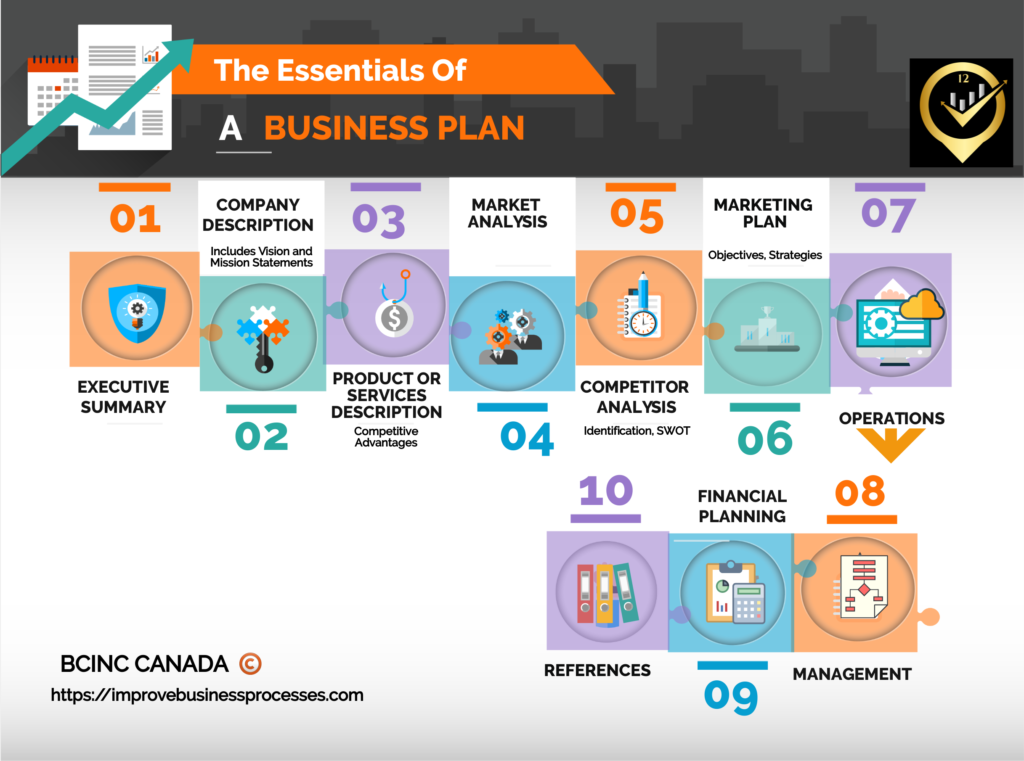
- Executive summary: Most important section and is written last
- Company description: Provides an overview of the business
- Products and services: Describe these in the context of the problem(s) they will solve
- Market Analysis: Identify target audience, competition
- Competitor Analysis: Identify the competition, SWOT analysis
- Marketing Plan: Objectives, Strategy, Campaigns
- Operations Plan: Product / Service delivery, Staffing
- Management team
- Financial plan: Income statement, Projected Cash Flow, Break Even Point
- References and Appendices
Following each of these sections methodically will create a plan suited to your business, however, there is a lot of work required and the right questions need to be asked and answered.
Unfortunately, many small businesses lack the skills to write their own plans and usually rely on the services of a company like BCINC Canada to ensure that they ask and answer the right questions and assist with cumbersome industry and competitor research.
Take back control of your business by developing your plan. Need assistance?
Conclusion
Knowing the essentials of a business plan is a critical first step towards developing one.
There are numerous templates online for creating these plans, but some owners prefer to engage the services of a company like BCINC Canada to ensure that the write-up is quickly and efficiently completed and done right.
References
SBA 2022. Write your business plan. https://www.sba.gov/business-guide/plan-your-business/write-your-business-plan


